
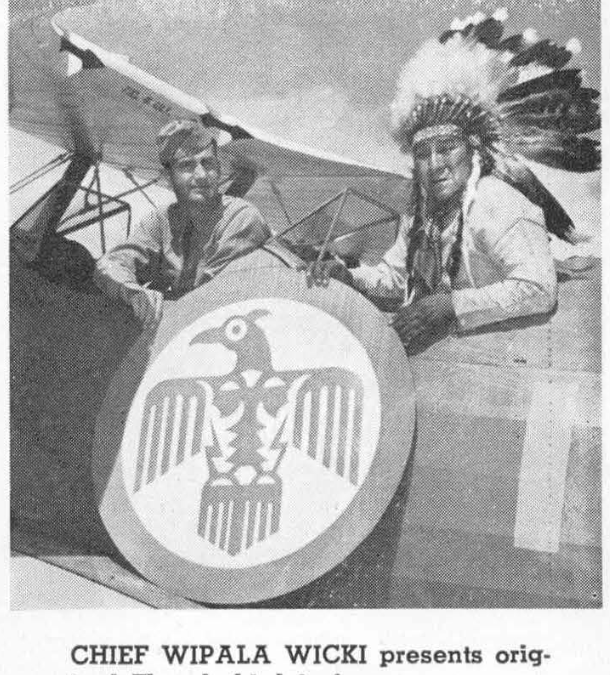
When Southwest Airways chose a name for their pilot training field, they used a familiar symbol. A “thunderbird” is a native American image with deep meaning, which varied between tribes but had some unifying elements. According to award-winning archeologist, Edward Lenik, the legendary thunderbird “causes lightening by flashing its eyes, thunder by beating its wings, and wind by its rapid flight” and is seen as a protector.¹ A Southwest Airways staff member explained in their publication, The Thunderbird, how the company reinterpreted some of this mythology into Thunderbird Field’s logo. He stated the “Most frequent belief is that the Thunderbird represents a good luck talisman for one about to embark on a journey.” The single eye, on an eagle’s head turned to the side represents “ever watchful”. In Arizona, some Navajo artisans use three- to five-pronged wings representing the eagle feathers of the chief or leader. These prongs denote power. The Hopi associated the eagle, which is part of the Thunderbird family, with a sky god.² Since Thunderbird Field was designed to train the best pilots, and their mission was to defend the Allies in dangerous situations around the world, the symbolism fit well.
During World War II, the Thunderbird logo and pilots traveled the globe. Today the Southwest logo remains on the front of the Tower on our campus. Next time you walk by, stop and take a look. Not only appreciate the past pilots and their sacrifices, but be reminded of our own global mission today and pray for God’s watchful eye, protection and safety as we seek to transform culture with truth.
1. Edward J. Lenik, “The Thunderbird Motif in Northeastern Indian Art”, Archaeology of Eastern North America, 2012, Vol. 40, pp. 163-185, https://www.jstor.org/stable/23265141.
2. Charles A. Mathewson, “Legend of the Thunderbird”, The Thunderbird, Vol.1 no. 1. March 1943, 3.
 Phone:
 Email: